Las Grietas Lanzarote, a Free Mini Canyon Near Puerto del Carmen
Tucked between Tías and San Bartolomé on the slopes of Montaña Blanca, Las Grietas Lanzarote is a network of narrow fissures cut into the volcanic rock, barely ten minutes' drive from Puerto del Carmen. Ignored by the traditional guidebooks for years, this free, ticket-free site has quickly become one of the most sought-after photo stops in the middle of the island. We have added it to our round-up of things to do in Lanzarote because it delivers, in under an hour of easy walking, a striking contrast with the island's big-ticket attractions: no museum, no artwork, just ochre and grey striped walls that you squeeze your way through.
▸ The essentials at a glance
- Where: on the LZ-35 road between Tías and San Bartolomé, on the slopes of the Montaña Blanca volcano (around 600 m above sea level), in central Lanzarote.
- Price: completely free, no ticket and no booking required.
- How long: 30 minutes to an hour on site, longer if you are taking photos.
- Getting in: free roadside parking, then a tunnel under the LZ-35 and a short, gently uphill path.
- What to bring: sturdy closed shoes, water and sun protection (there is no shade whatsoever).
▸ Our real visit to Las Grietas (July 2025)
- We visited Las Grietas as a family on 14 July 2025, children included: exploring the main fissure caused no trouble at all, despite the blazing midsummer heat.
- Our lesson learned on the day: shorts and a vest top are not the right call in the tightest sections — a few scrapes on the arms from brushing the rock convinced us a longer-sleeved t-shirt and light trousers would have been the smarter choice.
Where is Las Grietas on the map of Lanzarote?
The site sits right in the middle of the island, on the flanks of the Montaña Blanca volcano at roughly 600 metres above sea level, along the LZ-35 road linking Tías with San Bartolomé. That central position explains much of its appeal: it is easy to reach from most of the resorts, and on a clear day the altitude opens up long views over the south coast and down towards Puerto del Carmen.
In practice, allow about ten minutes by car from Puerto del Carmen, and only slightly more from Arrecife airport. That makes it an ideal stop at the very start or the very end of a holiday, when you still have a couple of hours to fill before dropping off the hire car. Coming from Costa Teguise or Playa Blanca, it slots naturally into a day spent discovering the interior, when you swap the coast road for the inland routes.
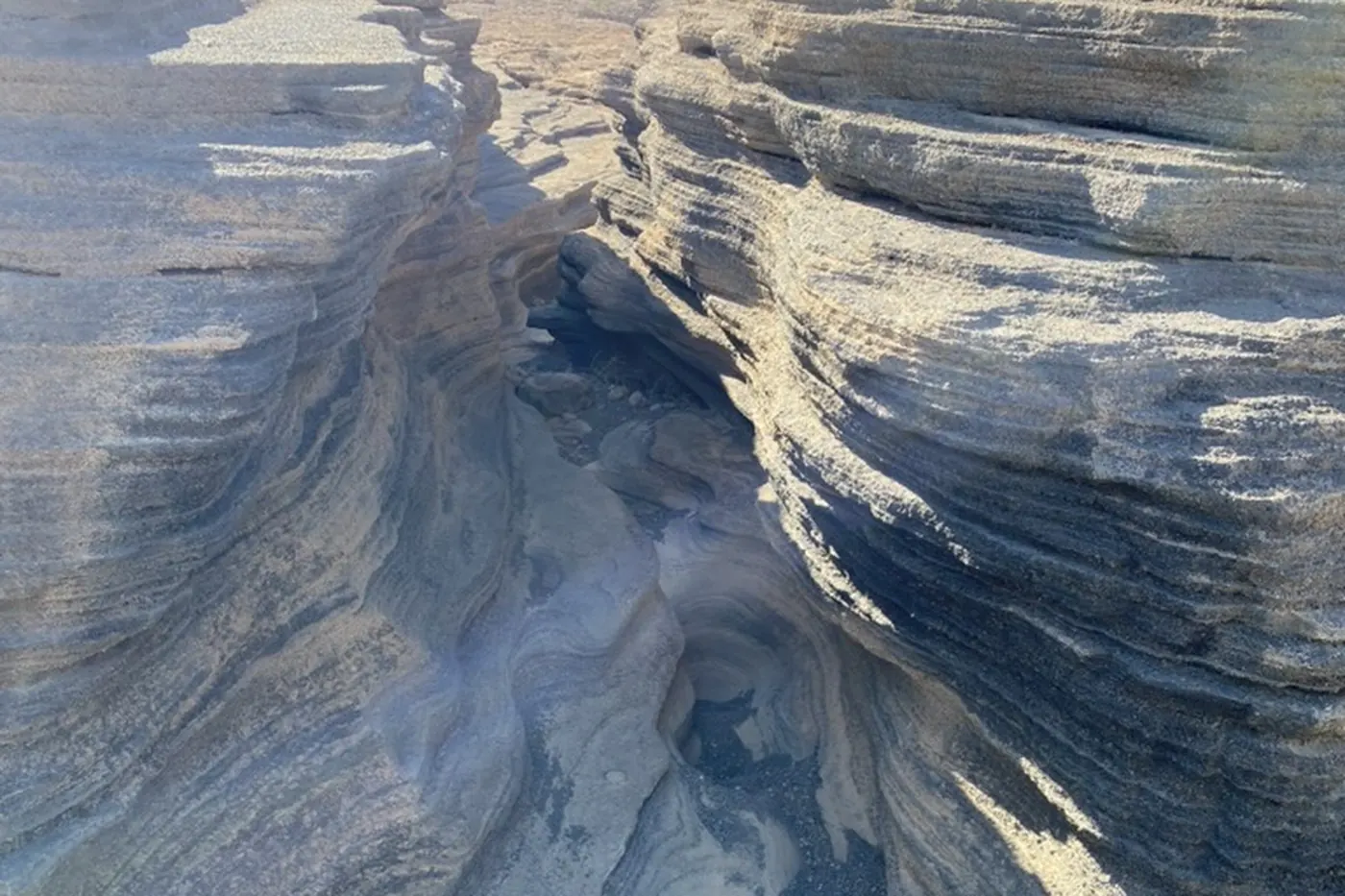
How do you get to Las Grietas Lanzarote, and where do you park?
Getting to Las Grietas Lanzarote from Puerto del Carmen needs no shuttle and no organised excursion: a hire car is far and away the simplest option, as no bus route serves this stretch of the LZ-35 directly. Once you arrive, a free parking area runs alongside the road. It is not officially marked out and amounts to little more than a wide strip of earth and volcanic gravel, but there is usually enough space, even in the middle of the day.
One point that matters for families: an underpass now lets you cross beneath the LZ-35 safely to reach the site from the car park. It used to mean walking across the road itself, which is no longer the case. Beyond the tunnel, a short path on a gentle incline, over volcanic gravel and sand, leads to the entrance of the fissures, which are already visible from the parking area. The whole approach takes only a few minutes on foot, with nothing technical about it.
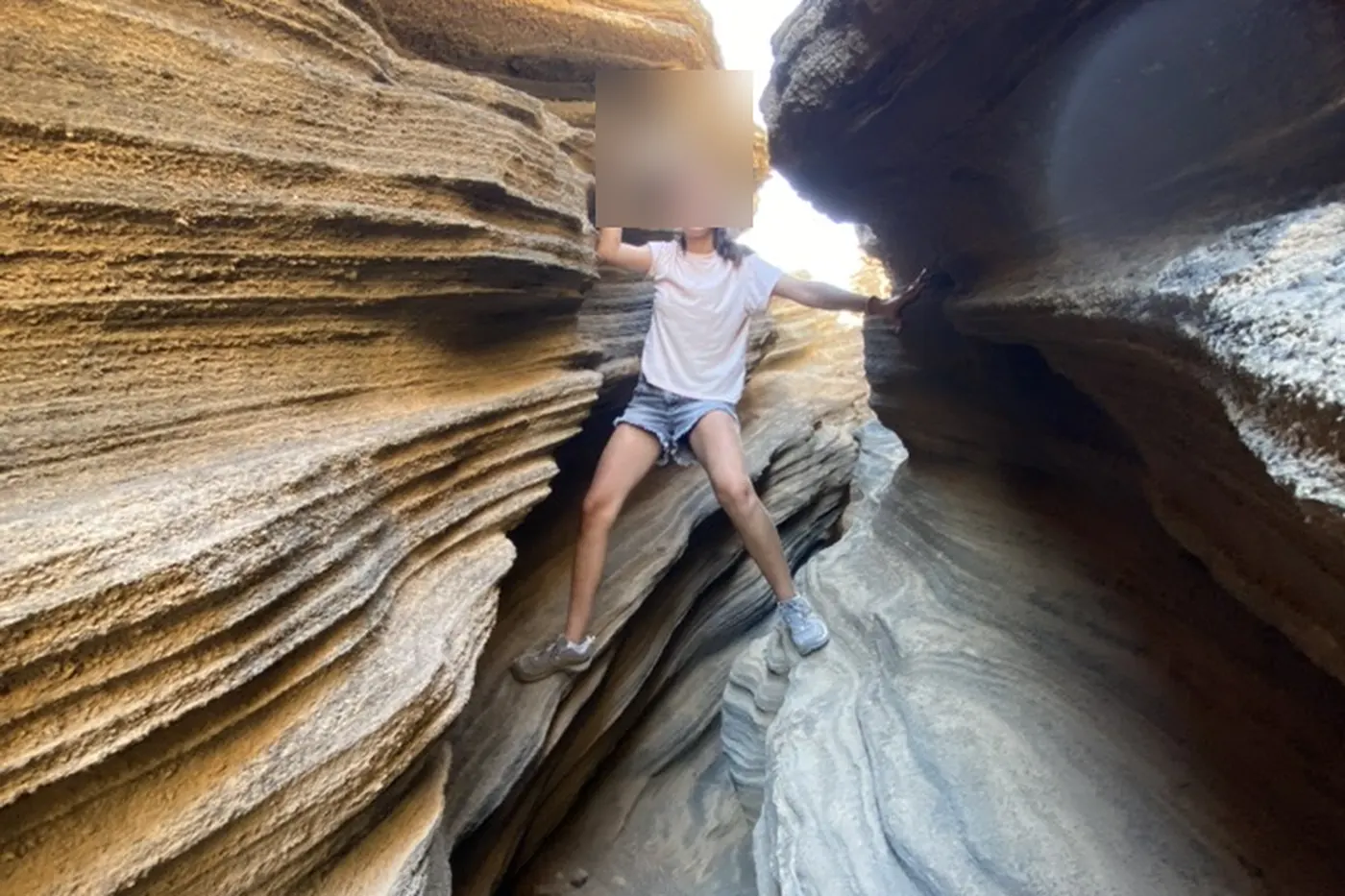
What are these volcanic fissures actually like?
There is no mystery behind the name: in Spanish, "las grietas" simply means "the cracks", or "the crevices". What you find is a series of extremely narrow canyons, the kind English speakers call slot canyons, cut into the volcanic rock of the mountain. The main fissure, and the most impressive one, runs for around twenty metres between walls so tight in places that you have to turn sideways and lead with one arm.
The layering is what stays with you. The walls read like a cross-section of successive lava flows and sediments built up over thousands of years, in a palette of ochre, grey and beige that low-angled light makes almost vibrate. Two explanations circulate in the available documentation about how the site formed. The first suggests these clefts are cooling fractures, opening up as the lava contracted against underlying rock of a different nature. The second puts them down to gradual erosion, with rainwater running down the slope century after century. Both theories sit side by side, and nobody expects a visitor to pick one.
There is another quirk worth being honest about: unlike Timanfaya or the sites shaped by César Manrique, there is no documented human or cultural history here at all. No old legend, no known farming use, no heritage story. These narrow canyons carved into the lava owe absolutely nothing to human hands: the interest is purely geological and natural. Overlooked for decades, the crevices only emerged from obscurity fairly recently, propelled by social media. That is part of their raw appeal, and a good reason to fit them in alongside the better-known highlights of the island of Lanzarote.
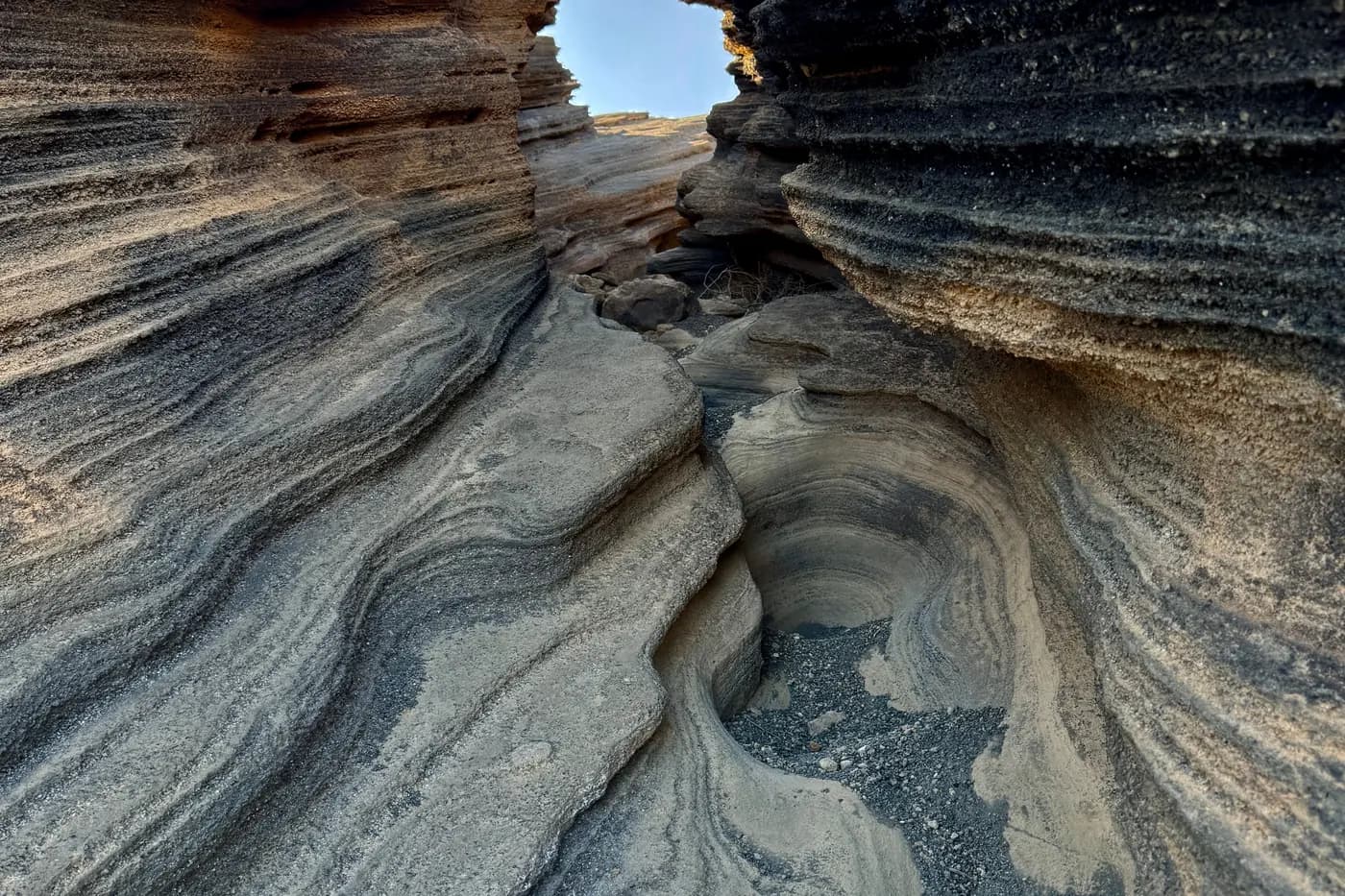
Cost, visit length and how accessible it is
The question of price is settled quickly: the visit is completely free. No ticket office, no booking, no opening hours. Access is open, which makes it one of the cheapest outings on the island, the polar opposite of the timed, paid tours at the big parks. That freedom comes with a trade-off: there is no visitor centre, no interpretation boards, no toilets and nowhere to buy a drink. Whatever you carry in, you carry back out.
Allow between 30 minutes and an hour on site to work your way through the main fissure at a relaxed pace and explore the smaller clefts nearby, and longer if you plan to take photographs or wait for the passage ahead of you to clear. Access is straightforward, the path only climbs gently, and it works very well as a family outing, provided you stay alert: the ground inside the fissures is uneven, and the roadside means holding little hands right up to the tunnel.
Our safety tips before you squeeze inside
Sturdy closed shoes are non-negotiable. The volcanic gravel is sharp, it chews through thin soles and rules sandals out entirely, and the ground can turn slippery in places, particularly on the sloping sections. Bring water and sun protection too: the site is fully exposed, with no shade anywhere apart from inside the fissures themselves.
One thing deserves saying plainly, because very few pages online mention it: in the tightest sections the volcanic rock has genuinely sharp edges. Simply brushing a wall as you shuffle through is enough to pick up scrapes on your arms, legs or hands. Nothing serious, but worth knowing, especially if you turn up in shorts and a vest top. A longer-sleeved t-shirt and light trousers save a lot of grazes, and keep your hands free to steady yourself.
Photographing the site: what is the best time of day?
Photography is largely what pulled this place out of obscurity. Some visitors describe it as a miniature version of Arizona's Antelope Canyon, and while the comparison asks for a good deal of generosity on scale, it holds where it matters: the play of light across the coloured strata, the silhouettes threading between the walls, and the glimpses of the sea and Puerto del Carmen framed by certain openings all add up to instantly recognisable images.
For the light, aim for mid-morning or mid-afternoon. At midday the sun drops straight down, contrasts turn harsh on the southern side and the shadows swallow the detail in the rock layers. In between, the light angles into the fissures and picks out the strata with far more depth. Those slots have a second advantage: they tend to be quieter than the middle of the day, when the island's driving circuits all converge on the centre at once.
All in all, this short, free stop slots neatly into a day on the inland roads, between two longer visits. To plan the rest of your trip across the archipelago, island by island, start with our Canary Islands travel guide.
Frequently asked questions
How do you get to Las Grietas in Lanzarote?
By car, along the LZ-35 road between Tías and San Bartolomé, on the slopes of Montaña Blanca. Allow around 10 minutes from Puerto del Carmen and a little longer from Arrecife airport. No bus route serves the site directly, so a hire car is the practical choice. When you arrive there is free parking along the road, then a tunnel takes you safely under the LZ-35 before a short, gently uphill path.
Is Las Grietas free to visit?
Yes, it is completely free. There is no ticket office, no booking and no opening hours, as the site is open access. The flip side is that there are no facilities on site at all: no visitor centre, no information boards, no toilets and no drinking water.
How long do you need at Las Grietas?
Between 30 minutes and an hour is enough to walk the main fissure, which runs for about twenty metres, and explore the smaller clefts around it. Allow longer if you want to take photographs or wait for the narrow sections to clear.
Do I need special shoes to visit Las Grietas?
Sturdy closed shoes are essential. The volcanic gravel is sharp and the ground can be slippery in places, so sandals and thin soles are a bad idea. Bring water and sun protection as well, since the site is completely exposed with no shade.
Can you visit with kids?
Yes, access is easy and the path only climbs gently, so it works well as a family outing. Do stay watchful with younger children though: the roadside means using the tunnel and holding hands, and the ground inside the fissures is uneven.
How were these volcanic fissures formed?
Two explanations circulate in the available documentation. The first is that they are cooling fractures, formed as the lava contracted against underlying rock of a different nature. The second puts them down to gradual erosion from water running down the slope over time. Either way, the walls show layers of lava and sediment built up over thousands of years.
Does the site have any history or legend behind it?
No, and it is worth saying so plainly: unlike Timanfaya or the sites created by César Manrique, there is no documented human or cultural history here. The name simply means "the cracks" in Spanish. It is a purely geological curiosity that stayed under the radar until social media popularised it in recent years.